
Policy
HIS Group considers "Reinforcement of Governance" to be a materiality, and we aspire to be a company which is trusted and chosen by stakeholders based on the HIS Group Philosophy.
In addition, each employee is working to engender a corporate culture and climate which respects the HIS Charter of Corporate Behavior and the rights and positions of every stakeholder
Corporate governance system
Diagram of Corporate Governance System
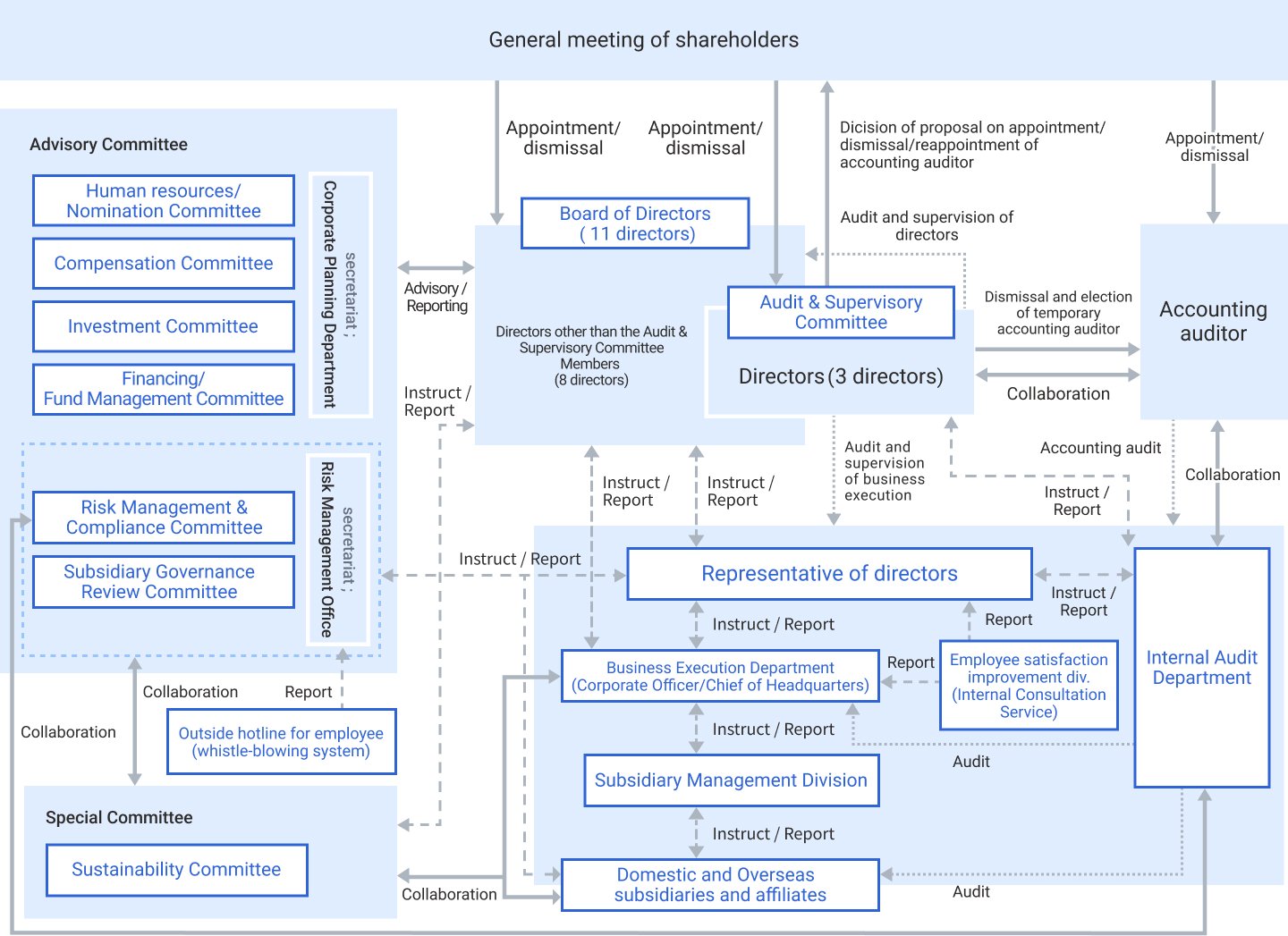
Board of Directors
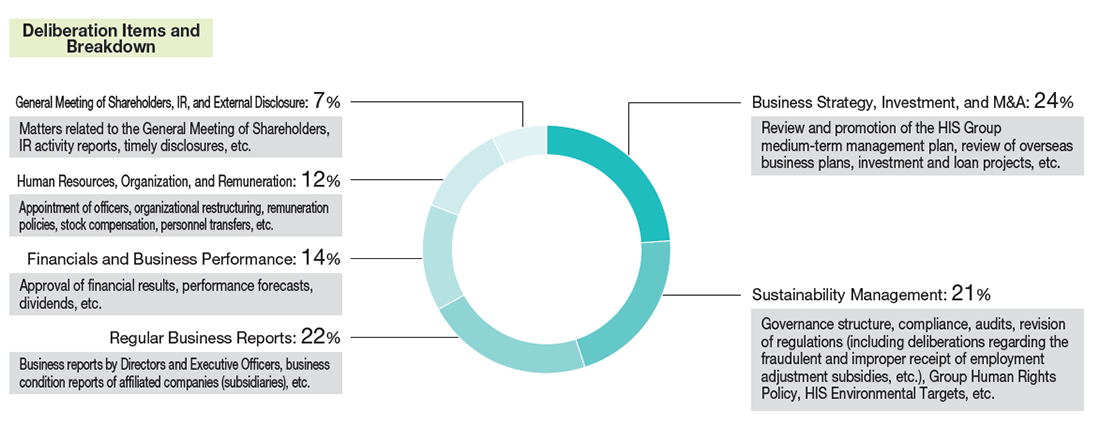
The Board of Directors emphasizes strategic discussions from a medium- to long-term perspective--such as the rolling of the HIS Group medium-term management plan and the promotion of sustainability--going beyond mere management supervision of operations. The Board also regularly receives reports on the business performance and risk management status of major group companies, working to reinforce governance across the entire Group and improve the effectiveness of internal controls. The contents of these deliberations and decided matters are appropriately recorded and managed. In accordance with laws, regulations, and the rules of financial instruments exchanges, we strive for the timely disclosure of information that contributes to constructive dialogue with shareholders and investors.
Audit & Supervisory Committee
and periodic opinion and information exchange sessions with the Accounting Auditor. Audit working papers prepared by full-time Audit & Supervisory Committee members regarding business departments, etc., are made available for review by part-time, External Audit & Supervisory Committee members, who provide necessary additional confirmations and recommendations.
Including the summary of daily audit activities, regular Audit & Supervisory Committee meetings are held in principle once a month.
Main Agenda Items Discussed and Exchanged Opinions On
・ Opinion exchange sessions with External Directors who are not Audit & Supervisory Committee members
・ Audit reports and opinion/information exchange sessions with the Accounting Auditor
・ Information exchange at the Group Corporate Auditors Liaison Committee
・ Investigations and audits related to compliance issues
Internal Audit Department
Governance Headquarter
early identification of potential risks in new businesses and strategic initiatives, as well as providing appropriate decision-making support to executive management based on objective evaluations. By collaborating closely with business departments and constructing highly effective risk response
measures, we will achieve both regulatory compliance and the maximization of decision-making speed.
Advisory Committees (Human Resources and Nominating Committee, Compensation Committee, Investment Committee, Capital Raising and Investment Committee, Risk and Compliance Committee)

Sustainability Promotion Committee
Board of Directors and Committee Composition, Number of Meetings Held and Attendance in FY2025
The Board of Directors*1, Investment Committee, Human resources / Nomination Committee, Financing / Fund Management Committee, Compensation Committee, Risk/Compliance Committee*2
*1 In addition to the above number of Board of Directors meetings, there were 6 written resolutions deemed to have been approved by the Board of Directors meetings.
*2 Risk and Compliance Committee changed its status from a task-specific committee to an advisory committee starting with its third meeting in April 2025. Due to changes in committee membership during the term, the number of meetings held varies by committee member.
| Position | Name | Independent Outside Director Member of Audit and Supervisory Committee |
Human resources / Nomination Committee | Compensation Committee | Investment Committee | Financing / Fund Management Committee | Risk / Compliance Committee | Number of sessions held / Number of times attended |
|---|---|---|---|---|---|---|---|---|
| Representative Director, Chairman | Yada Motoshi |
〇 |
◎ |
◎ |
◎ |
◎ |
◎ |
14/14
11/11 6/6 5/5 10/10 8/8
|
| Representative Director, President | Sawada Hidetaka |
◎ |
〇 |
〇 |
〇 |
〇 |
〇 |
14/14
6/6 10/10 5/5
|
| Director | Yamanobe Atsushi |
〇 |
〇 |
|
〇 |
14/14
11/11 8/8
|
||
| Director | Gomi Mutsumi |
〇 |
|
〇 |
|
|
〇 |
14/14 8/8 |
| Director | Iwama Yuji |
〇 |
〇 |
|
|
〇 |
ー
|
|
| Director | Sawada Hideo |
〇 |
|
|
|
ー | ||
| Independent Outside Director | Owada Junko | 〇 | 〇 | 〇 | 〇 |
14/14
11/11 6/6 10/10 |
||
| Independent Outside Director |
Matsumoto Koichi | 〇 | 〇 | 〇 | 〇 | ー | ||
| Director Member of Audit and Supervisory Committee |
Sekita Sonoko | 〇 | 〇 | 14/14 5/5 |
||||
| Independent Outside Director Member of Audit and Supervisory Committee |
Kaneko Hiroto | 〇 | 〇 | 〇 | 〇 | 〇 | 〇 |
13/14 11/11 6/6 5/5 10/10 |
| Independent Outside Director Member of Audit and Supervisory Committee |
Kagawa Shingo | 〇 | 〇 | 〇 | 〇 | 〇 |
14/14 6/6 10/10 |
Board of Directors Effectiveness Evaluation
Evaluation Process
|
Target Scope |
All 11 members of the Board of Directors (8 Directors who are not Audit & Supervisory Committee members, including 2 External Directors; and 3 Directors who are Audit & Supervisory Committee members, including 2 External Directors). |
|---|---|
| Evaluation Method | An anonymous questionnaire and tabulation were conducted via a third-party external organization. |
| Implementation Period |
The questionnaire response period was in September 2025, and discussions/evaluations based on the tabulated results were held in November 2025.
|
| Summary of Questions |
Composition of the Board of Directors / Operation of the Board of Directors / Discussions of the Board of Directors / Monitoring functions of the |
| Response Status |
Completed by all target members. |
Material Issues Identified from Evaluation Results
Main Improvements and Reflections
management and governance structure Placing high importance on reinforcing the risk management and governance structure, considerable time was dedicated to discussions, particularly regarding deliberations on the fraudulent and improper receipt of employment adjustment subsidies, etc. (including status reports on investigations by the Special Investigation Committee, identifying root causes, and formulating preventative measures). We are advancing the reinforcement of our corporate governance framework, including revisions to the Risk
/ Compliance Committee regulations and the temporary establishment of the Subsidiary Governance Review Committee.
B. Formulation of policies and execution plans to improve the diversity and expertise of Directors
To respond to the recent expansion of business domains, the advancement of digitalization, and the diversification of our human resource portfolio, an agreement was reached on the revision policy for the Directors' skills matrix. However, to enhance the effectiveness of the Board of Directors, we recognize the continuous need to discuss and examine constructing a management structure with a balanced combination of offensive and defensive capabilities by eliminating expertise imbalances and promoting diversity.
C. Vitalization of discussions regarding group-wide medium- to long-term strategies, including business portfolio restructuring
Aimed at restructuring businesses and strengthening our foundations, regarding business strategies, decisions were made on development investments in growth areas such as the hotel business, as well as investments in venture companies and funds. Concurrently, discussions were held to advance business streamlining to optimize management resources.
D. Setting quantitative targets for non-financial information such as sustainability and reinforcing effectiveness
We position respect for human rights as the core of our management. In December 2024, the "HIS Group Human Rights Policy" was formulated following a resolution by the Board of Directors. We are working to familiarize and instill this policy among our Group's officers and employees, establishing the foundation for human rights due diligence across the entire supply chain. Furthermore, as a response to climate change, we have set medium- to long-term $CO_2$ emission reduction targets, clarifying our commitment to realizing a sustainable society. Moving forward, the Board of Directors aims to improve effectiveness by repeatedly monitoring progress on a regular basis.
Future Issues to Be Addressed
B. Continuous discussion and reinforcement of supervision by the Board of Directors regarding the group-wide risk management and governance structure.
C. Enhancing discussions on sustainability promotion integrated with management strategies and improving effectiveness toward target achievement.
D. Formulation of policies and execution plans to improve the expertise and diversity of Directors.
Selection Process for the Management Structure and Human Resource Criteria
Succession Process
and appropriate deliberation processes. While executing aggressive strategies that utilize AI and technology with a sense of speed, we will simultaneously achieve management soundness and agility by thoroughly enforcing governance and reinforcing risk management, powerfully driving group management for a new era.
Human Resource Requirements for Chief Executive Officer (CEO) Candidates and Director Candidates: The "Three Capabilities"
1. Fundamental Capability (Kijiku-ryoku): "The capability to pass on the vision and philosophy to the next generation"
Aiming to be a company that lasts for 100 years, individuals who possess high personal aspirations, set short-, medium-, and long-term management visions, and execute management toward their realization. Human resources capable of executing management that connects to the next generation based on the philosophies consistently inherited since our founding.
2. Conceptual Capability (Koso-ryoku): "The capability to conceptualize corporate management and strategies that contribute to social progress"
Human resources who possess a global perspective, can conceptualize corporate strategies that contribute to social progress, human creative development, and world peace, and can lead management.
3. Execution Capability (Jitsugen-ryoku): "The capability to conceptualize strategies and realize them while valuing human resources"
Recognizing that "Human Capital" (or human resources) is the source of value creation generated through corporate activities, individuals who foster a "spirit of challenge" in each person, maximize strengths and diverse personalities, and develop successors for the next generation. Human resources who are admired as leaders, practice self-discipline, demonstrate fairness, openness, and sincerity through actions, and continuously realize strategic concepts.
Officer Remuneration
Policy Details
calculation methods for the performance-linked remuneration of Directors (excluding External Directors and Audit & Supervisory Committee members).
Rules related to remuneration calculation method and determination of remuneration
The amounts allocated to directors (excluding directors serving as members of the Audit & Supervisory Committee) are determined by the Board of Directors based on recommendations from the Compensation Committee, and the amounts allocated to directors who concurrently serve as members of the Audit & Supervisory Committee are determined through deliberation by members of the Audit & Supervisory Committee.
The policy for determining remuneration amounts is in accordance with the internal remuneration regulations established through deliberation by the Board of Directors and members of the Audit & Supervisory Committee and covers provisions related to the remuneration structure, remuneration determination criteria, and standard remuneration amounts
Remuneration policy
To have in place a competitive remuneration system with high degree of fairness
- Remuneration system and levels that are based on work responsibilities and performance (regardless of nationality or gender), and contribute to the acquisition
To have in place a remuneration system focused on improving corporate and shareholder value
- Remuneration system and structure that is closely correlated to earnings performance and focuses on improving medium- to long-term corporate and shareholder value
Remuneration composition
| Basic remuneration | Directors bonuses | Stock-based compensation | ||
|---|---|---|---|---|
| Remuneration type | Basic monthly remuneration | Performance-linked remuneration | Stock option | Restricted stock compensation |
| Share of remuneration | 40%-48% | 32%-40% | 5%-9% | 11%-15% |
| Time of payment | Monthly | Once a year | Upon completion of medium-term management plan | Upon retirement of each officer |
| Performance-linked or not | Fixed | Performance-linked | Performance-linked | Not linked to performance |
Basic Monthly Remuneration
Performance-Linked Remuneration
| Performance Metrics | Financial Metrics: Consolidated net income, Dividend payout ratio Non-Financial Metrics: Job satisfaction index |
||||||||
|---|---|---|---|---|---|---|---|---|---|
| Formula (Calculation Method) |
Total Performance-Linked Remuneration = Consolidated Net Income * (Consolidated Net Income Coefficient + Dividend Payout Ratio Coefficient + Job Satisfaction Coefficient) Individual Payment Amount = Total Performance-Linked Remuneration / (Total Position Coefficients of Full-time Directors * Position Coefficient) If significant extraordinary income or loss is recorded, the calculation may be adjusted to take it into account.
|
||||||||
| Scope of Evaluation |
Consolidated Subsidiaries |
Although the remuneration amount is calculated by multiplying each metric by a specific coefficient, these coefficients may be reviewed in the future to ensure a remuneration system that more closely reflects actual conditions in response to our medium- to long-term growth strategies, expansion of business scale, and changes in revenue structures.
Stock Options
Restricted Stock Remuneration
enhancing our corporate value. Simultaneously, it aims to promote further value sharing between eligible Directors and shareholders. The total amount will be issued within the annual limit (within ¥100 million per year) approved at the 37th Annual General Meeting of Shareholders held on January 25, 2018. (The base amount is calculated as: Basic Monthly Remuneration × Multiplier by Position).