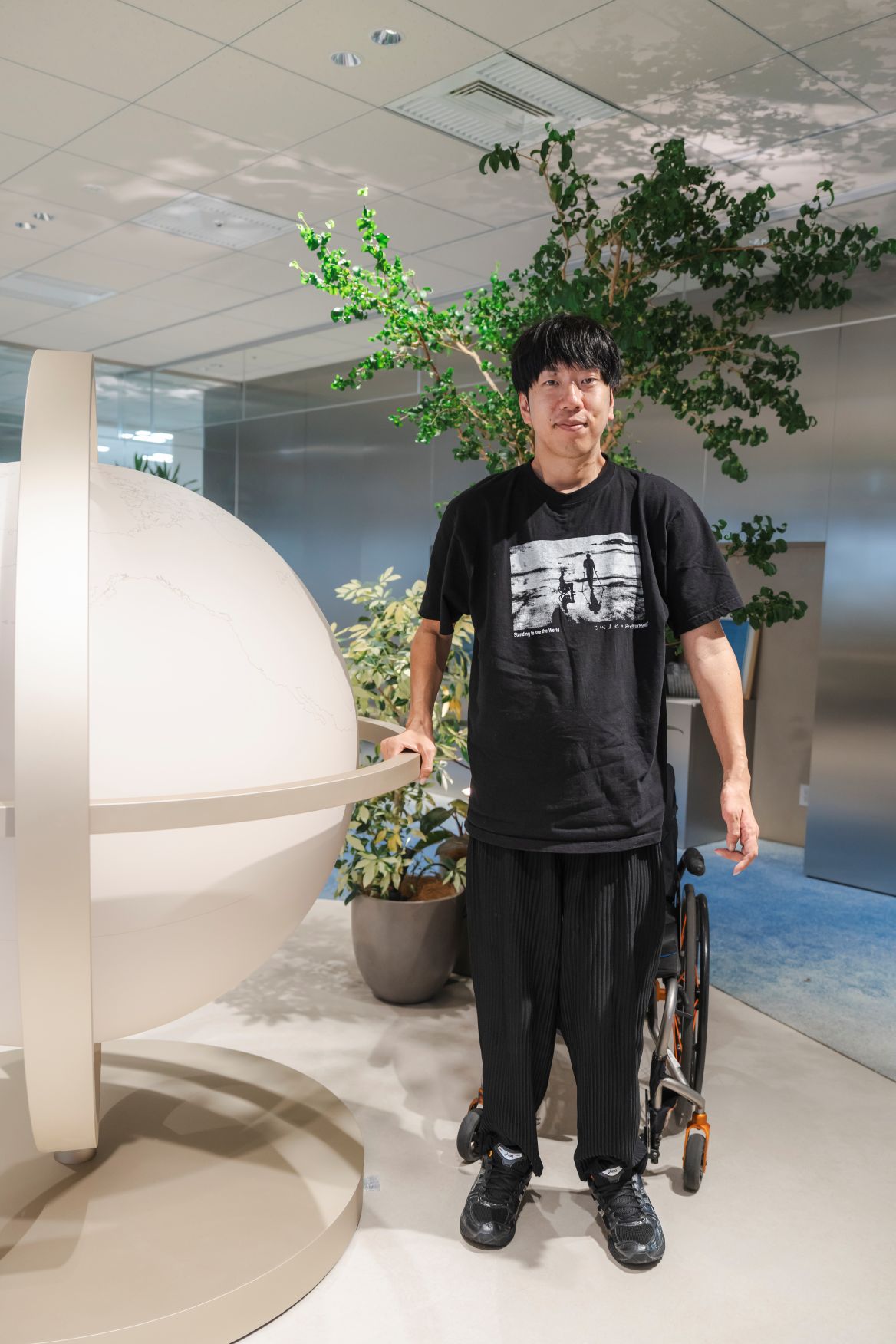

Footprints of a New Challenge: Walking Again Toward Uncharted Horizons
Dreams can be achieved through sheer effort. Memories of a world walked by a wheelchair traveler.
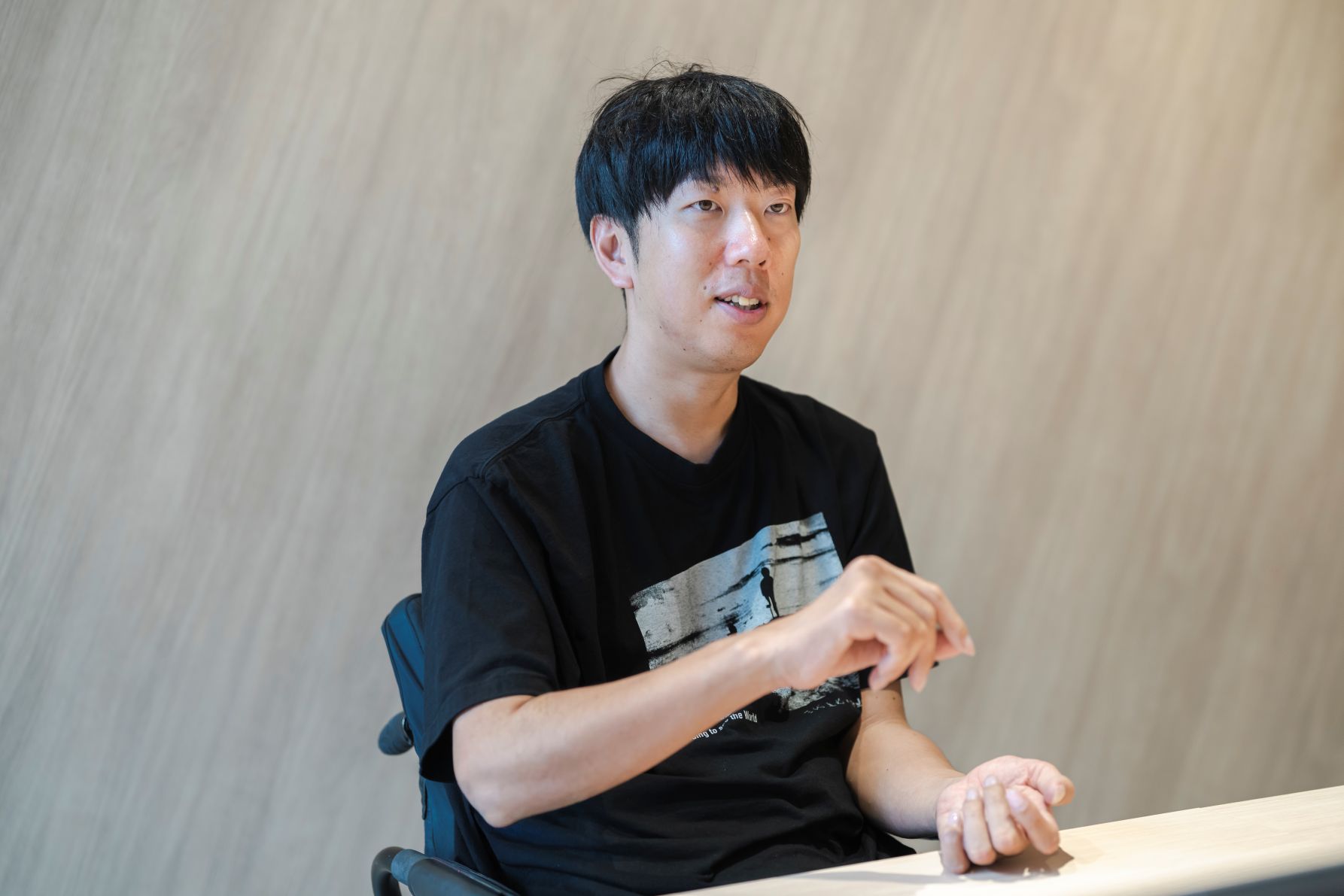
Tatsuya Miyo, who began using a wheelchair after sustaining a cervical spinal cord injury in a motorcycle accident at the age of 18, has embarked on a new stage of challenge eight years after his remarkable achievement of traveling around the world alone in a wheelchair. This new journey was a test of his own will to "stand and walk"--a quest to showcase the fruits of his gait rehabilitation on the global stage. Driven by a pure, intense longing to step onto the stairs of Machu Picchu and the ground of the Salar de Uyuni on his own feet, he overcame 10 months of grueling rehabilitation to take on his second trip around the world. We sat down with him to discuss his journey and his firm conviction that "anyone can transform their life at any moment."
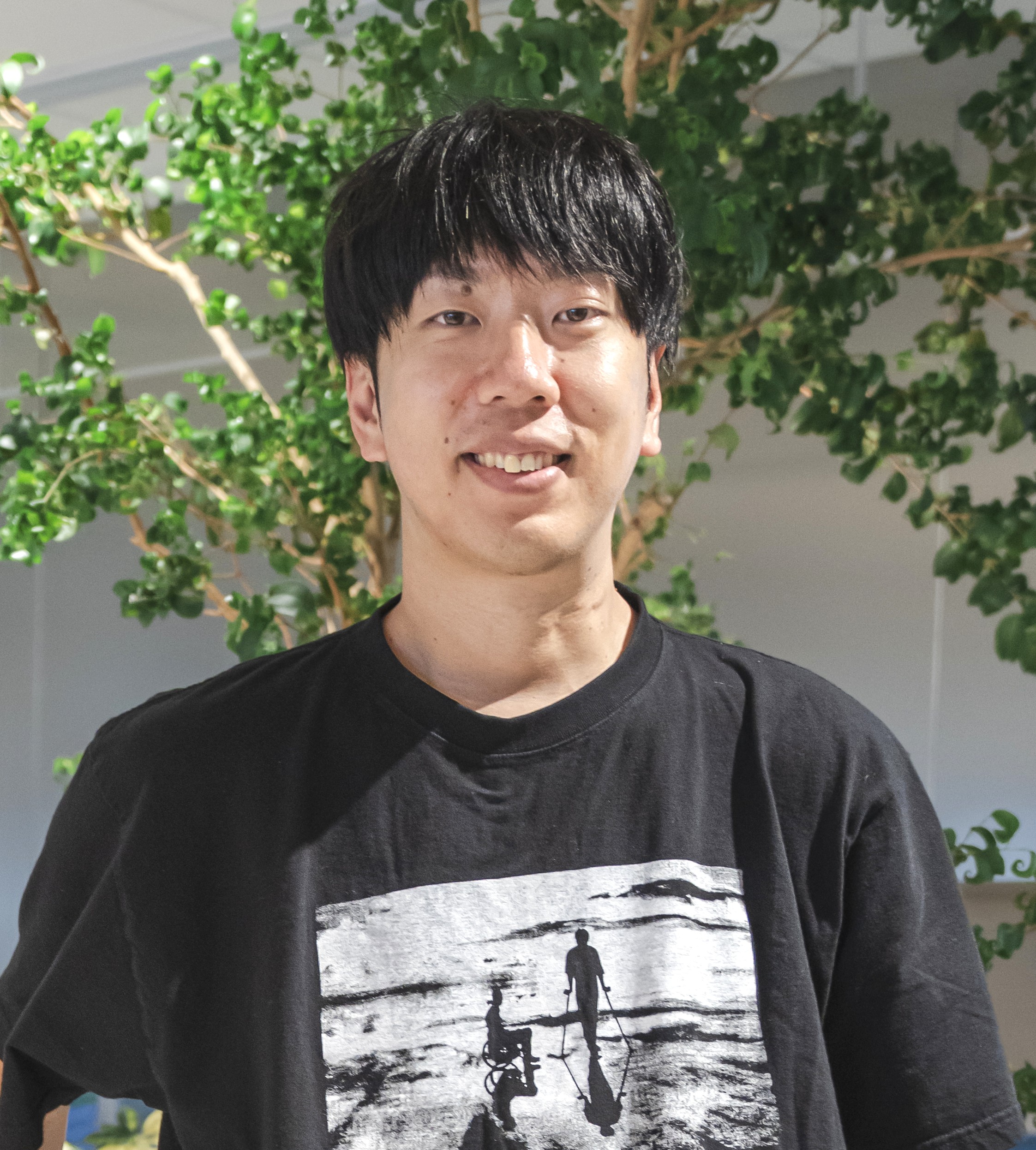
Miyo Tatsuya
After sustaining a cervical spinal cord injury in an accident, he transitioned to life in a wheelchair. Inspired by the advanced accessibility he experienced during a solo trip to Hawaii, he successfully completed a solo journey around the world in 2017, visiting 23 countries over approximately nine months. Currently based in Okinawa, he works as a wheelchair traveler, giving lectures and supervising tours. He is also actively involved in welfare education for students under the theme of "Education × Travel."
- YouTube: https://www.youtube.com/@miyochannel8798
- Instagram: https://www.instagram.com/wheelchair_traveler_miyo/
*The content of this article is accurate as of the time of the interview.
After facing the accident at 18, what was the moment or event that gave you the strength to start looking toward the future again?
I injured my cervical spine in an accident when I was 18. At the time, my rehabilitation was strictly focused on achieving the bare minimum needed for daily functioning. I just mindlessly went through the motions every day, doing exactly what the doctors and therapists told me to do. There was no personal will involved, and I couldn't see any purpose in moving my body or any hope waiting for me down the road. Although I could walk with a cane, I ultimately chose to live in a wheelchair because of its practical convenience.
For the next two years, my world revolved almost entirely around hospitals and rehabilitation facilities. In the midst of this hopelessness, there was one person who changed me--my roommate at the rehab center, who shared the same disability. He offered advice that was sometimes harsh, sometimes tender, but always pushing me forward. "Are you just going to settle for this?" he asked. "There has to be something left that you can do."
Pushed forward by his words, I finally found the courage to look toward the outside world. I started going out in my wheelchair, and when I decided to travel to Hawaii for my first overseas trip, a travel agency at a local mall rejected me, saying, "It's impossible to go alone." However, when I went to the HIS counter on the second floor of the same building, the agent welcomed me with a smile and said, "You can definitely go alone!" That encounter--where I was treated equally as a fellow traveler--became a massive driving force behind everything I do today.
After successfully completing your first trip around the world, what made you choose to jump back into such grueling rehabilitation, specifically focusing on learning to walk again?
My first trip around the world was a journey of pure joy, traveling completely solo without any caregivers and simply feeling grateful just to be there.
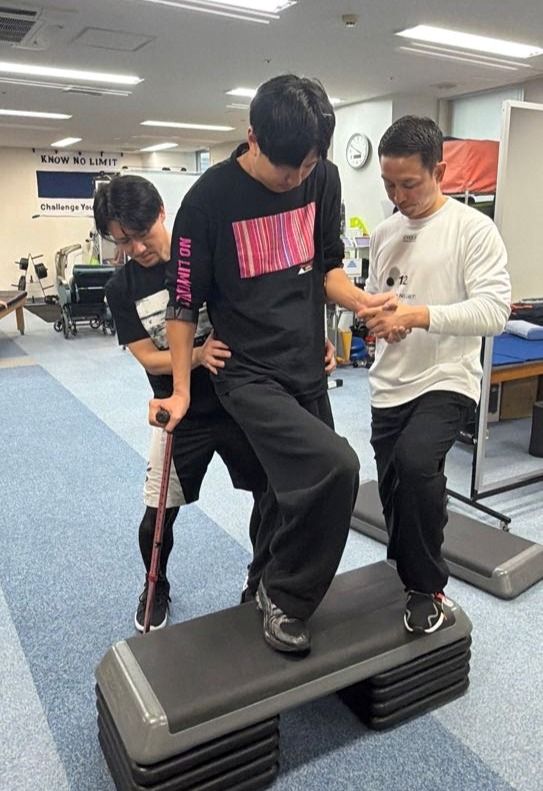
Eight years later, I had the opportunity to visit J-Workout, a specialized training gym for spinal cord injuries in Osaka. There, the manager asked me a question that sparked a desire I had never felt before: "Your legs can still move, so why aren't you walking? If you could walk, what would you want to do?" I thought to myself, "How incredible would it feel to walk around the world on my own two feet next time?" That feeling became the catalyst that led me back to "walking"--something I had once completely given up on.
The 10 months that followed became the most intense and grueling rehabilitation period of my life. Once a month, I would travel to J-Workout, while continuing my heavy training at my regular gym back home in Okinawa. To push myself even harder and create an environment where I couldn't slack off, I streamed my daily workouts live on social media.
I'm sure this journey was incredibly demanding, involving 21 flights in just 41 days. How did you manage the physical strain and risks?
Indeed, sometravel times alone took up to 30 hours, and the physical strain was beyond imagination. For wheelchair users, the greatest enemy is a pressure ulcer--commonly known as a bedsore. Able-bodied people shift their posture unconsciously, but for someone like me with diminished sensation, sitting in the same position for hours carries the risk of open wounds expanding or developing infections. I lived with this constant fear for all 41 days of the journey.
This time, however, a "team" of healthcare workers and rehabilitation professionals accompanied me on the journey. Thanks to their meticulous care of my physical health, I was able to focus entirely on the challenge. On the logistical side, HIS played an incredibly massive role. From applying for visas to unique countries like Turkmenistan, to arranging complex flight itineraries and confirming ground assistance at every airport--they professionally built the foundation of the trip, handling things that would have been impossible to manage alone.
Having that specialized backup allowed me to keep looking forward as a"creator." The fact that I could face my body and mind and complete such a rigorous itinerary was entirely due to the support rooted in their reliable expertise.
How would you describe the feeling when you finally set foot on the ground at your destination?
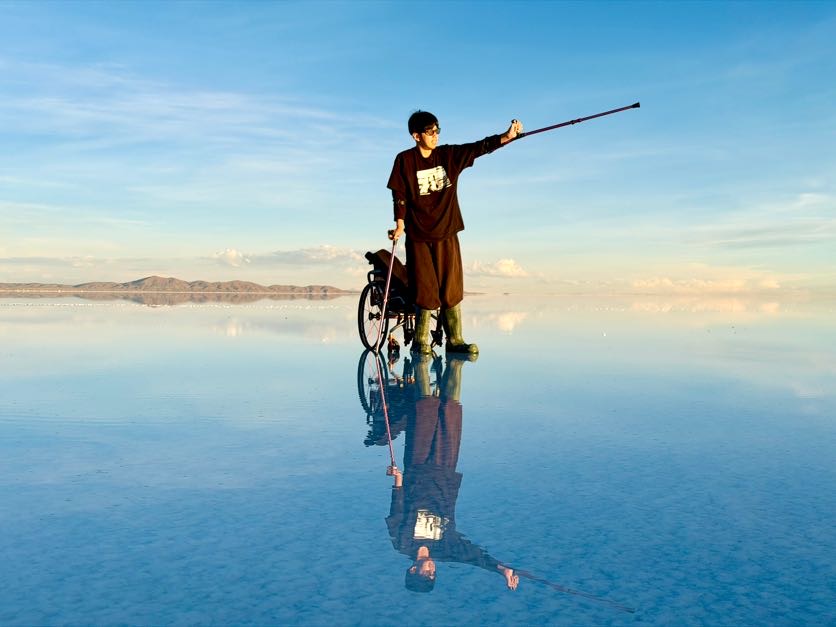
Standing on the ruins of Machu Picchu, the white expanses of the Uyuni Salt Flats, and before the pyramids of Egypt--the exact moment I arrived and stood there on my own two feet, it felt as though all ten months of rehab and the long struggle since the accident were finally rewarded. It was a truly a "KOKORO ODORU" experience.
The risk and fear of falling and severely injuring myself were always there. And yet, spreading out right before my eyes was a scenery that the version of me from those 16 years--when I had given up on ever walking again--could never have dreamed of. The risk and fear of falling and severely injuring myself were always there. And yet, spreading out right before my eyes was a scenery that the version of me from those 16 years--when I had given up on ever walking again--could never have dreamed of.
Through your journey, people have come to view you as a "trailblazer and a pioneer." How do you personally handle these expectations?
Being viewed in that light gives me immense pride and serves as an incredible emotional anchor to keep going. Back when I was spending my days in hospitals and rehab facilities, completely lost as to my purpose, I could never have imagined that a day would come when people would tell me I am a guide for others.
For me, the word "pioneer" carries a profound realization that this challenge--which I could never have achieved alone--was built together with the people who walked alongside me. The expectations from those around me never feel like pressure. Rather, if my continued challenges and my honest sharing of both the hardships and joys can ease even a single worry for the next person in line, then that is the exact moment my disability transforms into value. Having companions who believe in the possibilities of a new kind of travel--it is because of their support that I feel I can confidently keep walking forward, always searching for sights I have yet to see.
Through your travels around the world, what have you come to realize about Japan's barrier-free infrastructure?
Japan is world-class when it comes to the "hardware" aspect of accessibility--meaning the physical infrastructure. Major stations and shopping malls are almost always equipped with elevators and accessible restrooms. However, when it comes to the "software" aspect--people's awareness, flexibility, and looking at things from the perspective of those directly affected--there is still a lot we can learn from other countries.
There is a quote I deeply value: "Nothing About Us Without Us." When it comes to developing accommodations and public transportation, I often wonder how much the actual user's perspective--how we genuinely feel and utilize these spaces--is reflected from the very beginning of the planning stages. For instance, even the height of a simple hotel fixture might seem fine on paper, but the reality is that minor inconveniences still remain that you wouldn't notice unless you actually tried to approach them from a wheelchair.
On the other hand, in many places overseas, even where the infrastructure fell short, I was saved time and again by the sheer warmth of the people. For example, when the terrain in South America was too rough and I couldn't move forward, a crowd of bystanders gathered and lifted me up together. In that moment, I felt a deep sense of compassion. Across the globe, there are countries where this natural instinct to help one another is passed down through generations. My hope is that Japan, too, can become a country where this kind of heart is deeply rooted, going beyond just having the right infrastructure.
Part of the reason why I share the raw struggles and joys of my travels is because of this hope.
Finally, what is your vision for your future activities, and what message do you have for the next generation?
Following this journey, I felt a strong desire to focus my efforts particularly on the field of "education." When speaking to elementary and junior high school students, I often share insights about the subtle designs in our everyday surroundings. For instance, I tell them that roads are built slightly higher in the center for drainage, but this actually forces a wheelchair to drift to the side, making it much harder to push. While I want to continue sparking these kinds of realizations, I am also deeply committed to actively delivering my message to students studying rehabilitation.
I want to tell the students who are future therapists that I hope they become the kind of professionals who encourage patients to truly enjoy their lives. Just as I once did, people working through rehab after an accident or illness aren't simply looking for "functional recovery." What they truly need is a purpose--a vision of what wonderful things are waiting for them beyond that rehabilitation.
The greatest lesson I learned from this journey is that, given the right catalyst, it is never too late for someone to transform their life. By nurturing therapists who can provide hope for the future, I want to contribute to a society where people--who deserve every opportunity--never have to give up on their dreams because of a disability or illness.